
Today ‘Bluetooth’ is a technology that has become a household name, as ubiquitous as the internet itself. Like its older brother ‘Wifi’ the term is in common usage while its etymology is less well known. The name refers to King Harald “Bluetooth” Gormusson, famous for unifying the kingdoms of Denmark and Norway in 958 C.E. The logo for the technology itself is actually a union of two runes from the Younger Futhark viking language: Hagall (ᚼ) and Bjarkan (ᛒ).
The technology dates to 1998 when the Swedish company Ericsson convened a group of telecom manufactures to form the Strategic Interests Group (SIG) and develop a new set of wireless communications standards. They were particularly interested in the ability to link small, personal devices together, without the need to for a traditional wireless router to act as an intermediary. This type of peer-to-peer wireless network was christened a Personal Area Network (PAN) and Bluetooth 1.0 debuted a year later in 1999.
As of writing this, Bluetooth is currently on Core Standards Specification release 5.3 in its evolution. It operates in the 2.4 GHz band of the electromagnetic spectrum to enable data transmission between any two Bluetooth capable devices. However, starting with Bluetooth 4.0 the standards actually specified two distinct, non-interoperable technologies. The original set of standards is now known as Bluetooth Classic (also called Bluetooth Basic Data Rate/Enhanced Data Rate). It utilizes 79 x 1 MHz channels in the 2.4 GHz band of the spectrum for data transmission between linked devices, with adaptive frequency hopping for reduced interference.
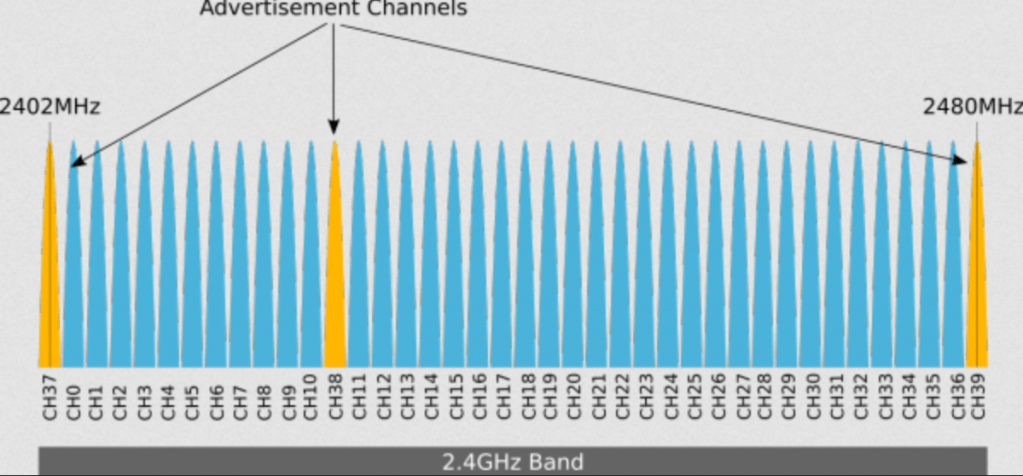
However, as part of the Core Standards Specification 4.0 standards release, the SIG also introduced a separate version geared toward lightweight communications with low power consumption. This protocol was initially know as “Bluetooth Smart” but has since been rebranded “Bluetooth Low Energy” (BLE). It divides the same portion of the 2.4 GHz spectrum band into 40 x 2 MHZ channels, with 3 being used for advertising channels and the rest for data transmission.
The bifurcation of the Bluetooth standards body into two distinct protocols was deliberate step to pave the way for a new generation of connected devices. Bluetooth Classic remains the preferred choice for use cases where a steady, (relatively) high bandwidth of data flow is required between two devices (e.g. audio streaming between a smartphone and wireless headphones). However, in other use cases BLE can be more advantageous.
Both Bluetooth BDR/EDR and BLE are capable of transmitting up to 100m in open areas, although their practical ranges are often less. BLE data transmission rates cap out slightly lower at 2 Mb/s vs Bluetooth Classic’s 3 Mb/s. The key advantage of BLE is its low power consumption. This revamp of the standards was designed to enable a new generate of Internet of Things (IoT) devices that are less concerned with transmitting data than they are with transmitting their presence, position, or state. Such transmissions require only minimal amounts of data in a highly compact format.
This standard has enabled the development of previously unimaginable devices. Apple Air Tags utilize BLE to provide real time location services from a miniaturized, self-sealed unit with a battery life that can last multiple years. Another very interesting application of BLE is in Bluetooth Beacons. These are small, geo-aware units that emit a one-way transmission designed to be picked up by special services listening on a device’s Bluetooth interface. These transmissions enable real time positioning with a location granularity down to the specific room of a building.
However, observing the new world of BLE communications that is growing around us, in real time, is rather more tricky. While the chipsets in most modern devices can receive and process Bluetooth traffic for their own purposes, they are not readily tailorable to custom applications like general purpose packet sniffing. Getting a first-hand look at the way BLE traffic intersects with our daily lives will require a more… creative approach.
 Viking Industries